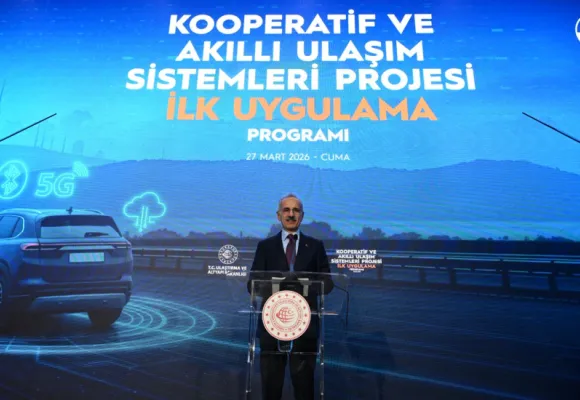
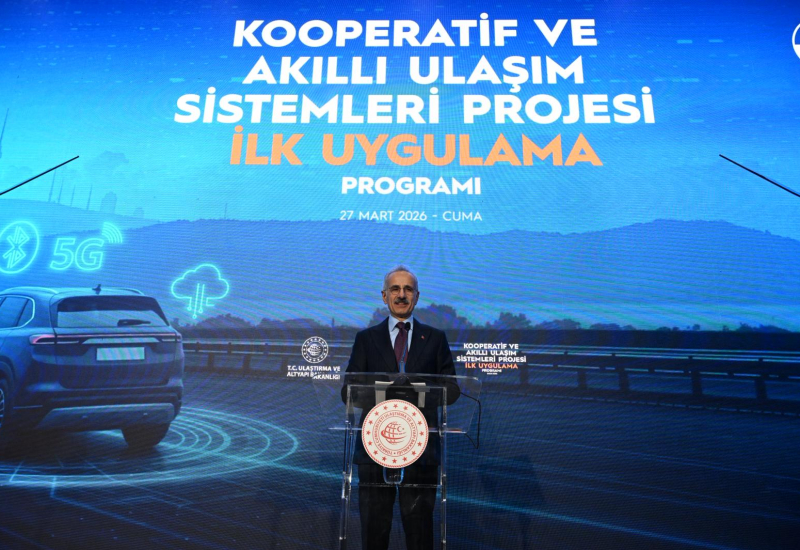
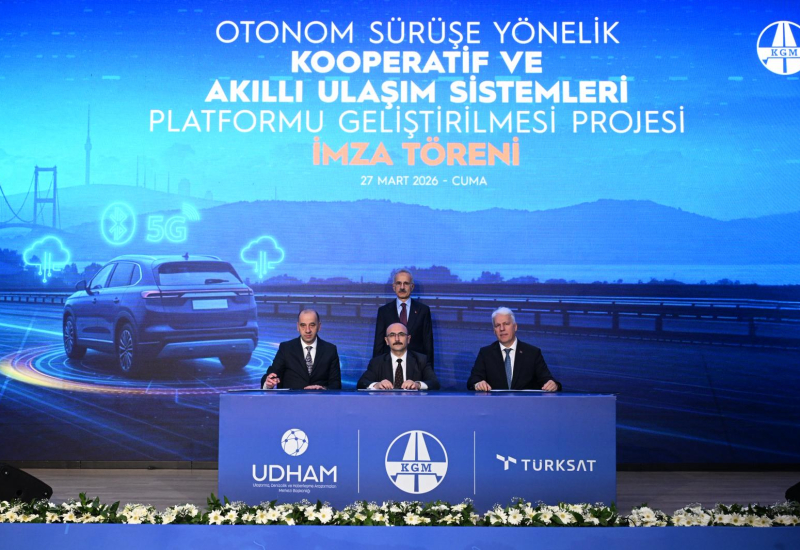
The Cooperative Intelligent Transportation Systems Project, implemented in cooperation with Türksat Satellite Communication Cable TV and Operations Inc., the Transportation Maritime and Communication Research Center (UDHAM), and the General Directorate of Highways (KGM), under the coordination of the Ministry of Transport and Infrastructure, has been implemented for the first time in Istanbul on a 40-kilometer route between Hasdal Junction and Istanbul Airport. Speaking at the commissioning ceremony of the system, Minister of Transport and Infrastructure Abdulkadir Uraloğlu said, "Thus, we are making travel safer, more comfortable, more efficient, and environmentally friendly."
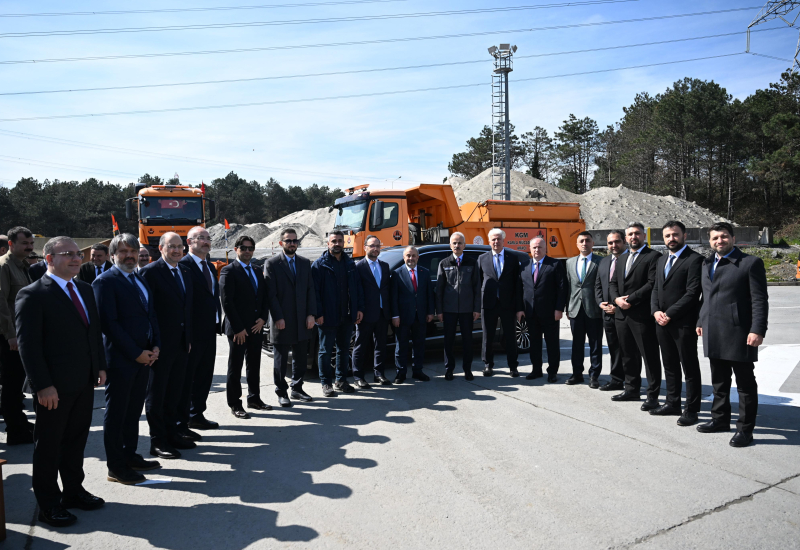
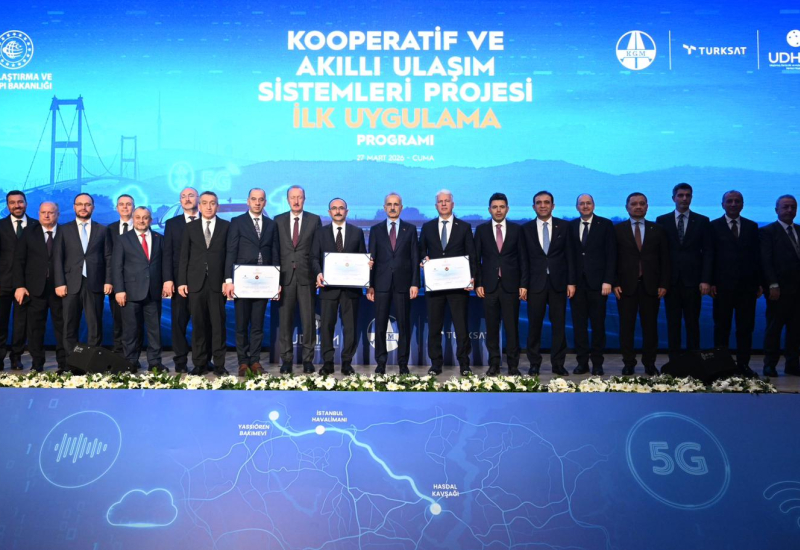
The first field example of the "Development of a Central Software Platform for Cooperative Intelligent Transportation Systems (K-AUS)" project, which will digitize Turkey's transportation infrastructure, was launched with the participation of Minister of Transport and Infrastructure Abdulkadir Uraloğlu and Türksat A.Ş. Chairman of the Board Prof. Dr. The project was launched with a ceremony attended by Kemal Yüksek, Türksat A.Ş. General Manager Ahmet Hamdi Atalay, General Manager of Highways Ahmet Gülşen, and UDHAM President Selami Yazıcı. The first phase of the project, a 40-kilometer stretch between Hasdal and Istanbul Airport, saw the installation of a 5G-supported smart communication infrastructure, and the system has now been put into service. Completely developed through domestic R&D, the project, which includes 5G and fibre infrastructure installations, aims to maximize traffic safety and comfort on the road and significantly reduce travel time. All situations such as accidents, stationary vehicles, hidden ice, objects falling onto the road, or lane closures will be instantly detected by the system, and road users will be informed immediately. Cameras, road sensors, AI-based image processing, event detection, meteorological information systems, and variable message signs will also be implemented. This will increase the safety of citizens, allow for more effective and efficient use of the road network, and minimize unnecessary waiting times on the roads.
Advanced Technology Systems
Speaking at the event held at the KGM 1st Regional Directorate to mark the start of the project's test application, Minister Uraloğlu stated that in this era of rapid spread of the internet and autonomous vehicle technologies, transportation is no longer just about roads and vehicles, but has become an ecosystem where vehicles communicate intelligently with each other, with infrastructure, and with everything else. Uraloğlu stated that the K-AUS project, as a whole of advanced technology systems that enable mutual data sharing between vehicles and infrastructure elements through wireless communication, meets this need. "We are making travel safer, more comfortable, more efficient, and more environmentally friendly."
Pointing to the benefits of the project for drivers and road safety, Uraloğlu explained that the system will provide drivers with real-time and location-sensitive information regarding road, traffic, and environmental conditions. Uraloğlu stated, “Thus, we are making travel safer, more comfortable, more efficient, and more environmentally friendly. Today, we are commissioning the first field example in Türkiye where Cooperative Smart Transportation Systems are holistically applied in real traffic conditions on a route of approximately 40 kilometers between Hasdal Junction and Istanbul Airport. This is not just a pilot project, but the cornerstone, the brain, and the roadmap to the future of our country's domestic and national smart transportation vision. Every step taken here will strengthen the foundation of Türkiye's smart transportation infrastructure and illuminate the future.” All Data Will Be Collected on the Central Software Platform
Uraloğlu explained that this corridor includes many critical applications such as roadwork warning service, slow or stopped vehicle warning service, in-vehicle traffic signs and speed limit service, weather conditions warning service, and "Emergency vehicle approaching" warning service. Stating that all this data will be gathered under one roof by the Central Software Platform they developed domestically and nationally, Uraloğlu said, "Events will be automatically detected with artificial intelligence-supported image processing and transmitted to drivers without delay in milliseconds. With our mobile application, our road users will also be able to easily access real-time information."
The Second Phase Will Be Implemented in Ankara
Minister Uraloğlu emphasized that the fact that the project is domestic and national is of particular importance to them, saying, "Hopefully, on March 31st, we will announce our transition to 5G to our nation with a special ceremony that will be attended by our President, and we will make it available for use. Then, on April 1st, we will receive the first signal and test and use this high-speed experience together. The 5G infrastructure we have established in this corridor is actually one of the first concrete steps of this great transition." Uraloğlu stated that the Cooperative Smart Transportation Systems will exchange data within milliseconds thanks to 5G's low latency and high bandwidth, thus ensuring that both this project and all future smart transportation applications will operate much more powerfully and seamlessly. Underlining that this project will not be limited to Istanbul, Uraloğlu said, “Following the successful completion of the testing processes, which we have no doubt will happen, the system will rapidly expand. We will move on to the second phase of applications on the Ankara Ring Road. We will implement this phase on an access-controlled highway consisting of 110 kilometres of main road, connecting roads, and junction arms. Thus, we will expand the system's capabilities under more complex traffic scenarios in Ankara.”
Following the speeches, the signatures for the Cooperative Smart Transportation Systems Project were signed by TÜRKSAT AŞ Chairman of the Board Kemal Yüksek, General Director of Highways Ahmet Gülşen, and UDHAM President Selami Yazıcı. After the event, the project's implementation began on the 40-kilometer route between Hasdal and Istanbul Airport. Minister Uraloğlu took a test drive in the Togg vehicle on the application corridor.